Education and Labour Solutions for Renewable Energy in the Western Balkans
This project component focuses on advising vocational education and training organisations on the opportunities, needs and content requirements of vocational education and training for a renewable energy-based transition. The component ended in October 2025.
Outputs: Basics for vocational education and training (TVET) for RE
- Analyze expected employment effects and skilled labor requirements of a RE- based energy transition
- Roll-out an information campaign on professional perspectives and attractiveness of green jobs among the energy transition of Western Balkans
- Together with vocational education and training institutions of the Western Balkan countries, develop a recommendation package consisting of regionally standardized learning contents and recommendations for the technical equipment of vocational education and training institutions for RE
- Update skills & knowledge for a RE-based energy transition of existing RE specialists and representatives of further education institutions by means of pilot (master) trainings.
- Development and piloting information campaigns with RE industry associations and chambers to promote good craftsmanship and technical quality to RE investors/end-users
- Identify options for coal sector professionals to retrain for the energy transition ("RE qualification") and advise organizations for professional development
Objectives
- Two gender-sensitive information campaigns on the opportunities, needs and content requirements of vocational education and training for the energy transition were carried out by national or regional VET organisations in three WB countries
- Three VET organisations from three WB countries have developed in regional exchanges a package of recommendations on education and training for a RE-based energy transition.
Main Activities
- Analyse expected employment effects and skilled workers’ needs of a RE-based energy transition, conceptualise information campaign
- Develop a package of recommendations with vocational education and training institutions in the WB
- Develop an information campaign with RE-industry associations together with NGOs and identify options for re-skilling (i.e. fossil fuel based extraction/generation)
Expected Impacts
- VET organisations are familiar with the opportunities, needs and content requirements of education and training for an energy transition based on renewable energies.
Project Deliverables
Reports and Publications
Labor Market Effect Analysis - Energy Transition and Jobs in the Western Balkans

Labor Market Effect Analysis - Energy Transition and Jobs in the Western Balkans
This study aims to assess the labour market impacts of transitioning to a decarbonized electricity sector in the Western Balkans. It specifically focuses on:
- Estimating job losses from phasing out fossil fuels and assessing the potential for job creation in renewable energy.
- Identifying key skills required in the energy workforce and analyzing existing skill gaps.
- Examining macroeconomic key challenges and opportunities, and evaluating how well the supply of skilled professionals matches the evolving demand for skills in the renewable technology sector.
The report has been released by the ‘Green Agenda: Decarbonisation of the Electricity Sector in the Western Balkans’ project funded by the German Ministry for Economic Cooperation and implemented by GIZ.
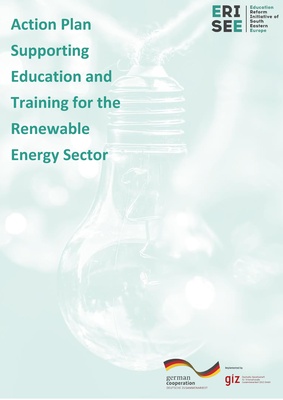
Action Plan Supporting Education and Training for the Renewable Energy Sector
Action Plan Supporting Education and Training for the Renewable Energy Sector
This Action Plan consists of three main segments:
- General mapping of the energy sector and the main policy framework relevant for the energy transition
- Contemporary discourse in the education sector on supporting the energy transition viewed as a potential driving force behind both the energy and just transition, the education sector finds itself at a critical juncture. While it holds significant transformative potential, it also faces structural limitations and competing demands that challenge its ability to fully support the transition in a timely and equitable manner. The segment is concluded with a set of recommendations.
- The results of the expert-based mapping process done by the VET and energy sector experts, representatives of ministries of education, VET and qualification agencies, chambers of commerce and business sector from six Western Balkan economies with the identified set of actions and recommended activities relying on the recommendations from the previous segment.
The Action Plan was developed within the Renewable Energy Services in Education and Training – RESET project by the Education Reform Initiative of South Eastern Europe - ERI SEE, in consultations with experts and stakeholders from the Western Balkans. It was published in September 2025.
Unlocking Circular Migration for the Renewable Energy Workforce in the Western Balkans

Unlocking Circular Migration for the Renewable Energy Workforce in the Western Balkans
This report examines how a circular migration approach could help address skilled labor shortages in the Western Balkans’ renewable energy (RE) sector, particularly in the photovoltaic (PV) subsector. With many skilled workers emigrating—mainly to Germany and other EU countries—while WB economies transition toward decarbonization under the Green Agenda, there is a growing need for qualified labor. Circular migration, where workers temporarily gain experience abroad and return home with enhanced skills, offers a potential “triple win” for origin countries, destination countries, and migrants.
The report analyzes migration trends, labor demand, and international best practices to develop a framework for applying circular migration in the RE sector, focusing on benefits, challenges, and policy tools. Drawing on data, case studies, and labor projections, it concludes with recommendations for designing programs that enable returning migrants to advance local energy transitions and broader development goals.
Factsheet - Unlocking Circular Migration for the Renewable Energy Workforce in the Western Balkans

Unlocking Circular Migration for the Renewable Energy Workforce in the Western Balkans
This factsheet gives an overview on how a circular migration approach could help address skilled labor shortages in the Western Balkans’ renewable energy (RE) sector, particularly in the photovoltaic (PV) subsector. With many skilled workers emigrating—mainly to Germany and other EU countries—while WB economies transition toward decarbonization under the Green Agenda, there is a growing need for qualified labor. Circular migration, where workers temporarily gain experience abroad and return home with enhanced skills, offers a potential “triple win” for origin countries, destination countries, and migrants.
Fundamental Assessment - Introducing Just Energy Transition Measures in the Western Balkans

Introducing Just Energy Transition Measures in the Western Balkans – Fundamental Assessment
This study analyzes the coal phase-out process in the Western Balkans and its significant social and economic impacts. The transition will strongly affect employment, household livelihoods, social inclusion, and gender dynamics, while many indirect jobs tied to the fossil fuel value chain will also be at risk. Beyond job losses, the shift will require extensive reskilling, upskilling, and worker mobility to adapt to new technologies. These changes will influence living standards, energy poverty, community cohesion, income distribution, and access to public services.
The analysis also provides best practices and policy resources to address gaps in just energy transitions in the WB. It draws on lessons from coal phase-out policies in Romania, the Czech Republic, and Slovakia, assessing their strengths and weaknesses to inform more effective regional strategies.
Teaching and Learning Materials
The materials include a set of recommendations for gradually increasing RE energy sector professions in the Western Balkans.
Manual for Teachers on the Installation and Maintenance of Solar Photovoltaic Systems
This manual provides VET teachers with practical guidance on how to teach the module, offering step-by-step instructions and tools.
Developed by Melanija Ćalasan and Marina Braletić, together with renewable energy experts and learning content developers, as part of the RESET project. Published in April 2025.
Download in:

Manual for Students on the Installation and Maintenance of Solar Photovoltaic Systems
Handbook for students (learning material) on solar PV.
Developed by Melanija Ćalasan and Marina Braletić, together with renewable energy experts and learning content developers, as part of the RESET project. Published in April 2025.
Download in:

Manual for Teachers on the Installation and Maintenance of Electrical Energy Equipment in Wind Power Plants
This manual provides VET teachers with practical guidance on how to teach the module, offering step-by-step instructions and tools.
Developed by Melanija Ćalasan and Marina Braletić, together with renewable energy experts and learning content developers, as part of the RESET project. Published in April 2025.
Download in:

Manual for Students on the Installation and Maintenance of Electrical Energy Equipment in Wind Power Plants
Handbook for students (learning material) on electrical energy equipment in wind power plants.
Developed by Melanija Ćalasan and Marina Braletić, together with renewable energy experts and learning content developers, as part of the RESET project. Published in April 2025.
Download in:
Events
RESET National Events: May–June 2025 Building bridges for sustainable energy learning

RESET National Events: May–June 2025 Building bridges for sustainable energy learning
From April till June 2025, twelve national events took place in all six Western Balkan economies within the framework of the Renewable Energy Services in Education and Training – RESET project. The events focused on promoting renewable energy in the context of education. All events included expert insights on labor market trends and the role of education in the green transition, with brief reflections on gender aspects in the energy workforce. The events also introduced regional teaching and learning materials (TLM) developed within the project — Installation and Maintenance of Solar Photovoltaic Systems and Installation and Maintenance of Electrical Energy Equipment in Wind Power Plants. During the events, participants learned about funding opportunities from the Regional Challenge Fund (RCF) and discussed ways to promote VET programs in renewable energy. The events were attended by representatives of adult education providers or secondary education institutions. Read more about the events here.
EduEnergy Conference: Building Bridges for Sustainable Energy Learning

EduEnergy Conference: Building Bridges for Sustainable Energy Learning 2024
The Edu-Energy Conference: Building Bridges for Sustainable Energy Learning brought together experts and stakeholders from across the Western Balkans to discuss the current challenges in the renewable energy sector and explore ways forward. The event, held online on 15 March 2024, focused particularly on the skills needed to support the growth of renewable energy. Key speakers provided insights into the current state of the energy sector and its future developments, as well as exploring the social response to these challenges. Read more about the event and access the presentations here.
EduEnergy 2.0: Towards Shaping the Future of Renewable Energy Transition in the Western Balkans

EduEnergy 2.0: Towards Shaping the Future of Renewable Energy Transition in the Western Balkans
The conference Edu-Energy 2.0: Towards Shaping the Future of Renewable Energy Transition in the Western Balkans brought together around 100 participants from across the region. It aimed to foster dialogue on the evolving role of the education sector in the Western Balkans’ transition to renewable energy. The discussions focused on the intersection of current and future labor market trends with social sustainability, economic inclusion, and gender equity. The conference was held online on 30 October 2024. Read more about the event and access the presentations here.