
Hydropower in Powering Agriculture
Overview
Worldwide, hydropower is the most widely used renewable energy resource due to its significant advantages over other renewable resources: high energy density, low cost and reliability in particular. Hydropower plants are available from very small sizes of only few Kilowatts (kW) to multi-Gigawatts (GW). Small hydropower plants, generally in kW range, are used for rural electrification in many countries and have high potential to be integrated into the agriculture value chain in those locations.
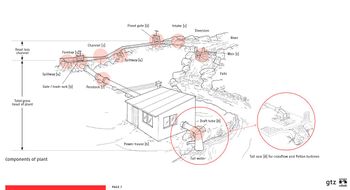
Hydropower, especially small-scale hydropower (up to 1 MW), works according to a simple principle: water from streams or rivers runs through a turbine, the turbine rotates and turns tools (pumps, mills etc.) or a generator which can produce electricity (see the componentsof a micro hydro power plant in the figure below). To achieve a reliable production of energy, it is important to have good knowledge about the local water resources and to design the system accordingly.
|
► For more information see the Micro Hydro Power Scout Guide. |
System Example: Smart Hydropower (In-Stream Turbine)
The Smart Hydropower turbine was developed to produce a maximum amount of electrical power with the kinetic energy of flowing waters. Because it is powered by kinetic energy and not with potential energy it is known as a so-called “zero-head” or “in-stream” turbine. As such, no dams and/or height differences are necessary for the operation of this device; the course of a river remains in its natural state and no high investments in infrastructure are required. Because the amount of kinetic energy (velocity) varies from river to river, the capacity of an in-stream turbine ranges: from a minimum of a few watts to a maximum of 5 kW.
Check out this video to learn more.
Calculation for the power equation:
P=ρ*q*g*h*η
q= water flow rate [m3/s]
h= head (falling height) [m]
ρ= density of water
(1000[kg/m3])
g= 9.81 [m/s2]
η= efficiency of the systems, usuallybetween 50% and 75% formicro/small hydro
Further Information
References