Webinar: Inclusive Energy Planning
Inclusive Energy Planning - Maximising the impacts of energy access by bridging between locality of people's livelihoods and (inter)national-wide energy governance
This digital seminar is the fourth in our joint series hosted by WISIONS in cooperation with the ACCESS Coalition’s Learning Group. It focuses on how to maximise the development effects of energy access.
To have an impact on development, energy access must start from the recognition of people’s specific aspirations and opportunities within their local contexts. But how can such local rootedness be applied in energy planning and policy processes of much larger scope, for example at provincial or national level?
For this online seminar, we invited experts from Malaysia and Kenya to share their experience. The panelists presented two case studies of inclusive and integrated energy planning processes.
Missed the previous seminar? It focussed on how energy access projects can facilitate the productive use of energy.
Inclusive Energy Planning
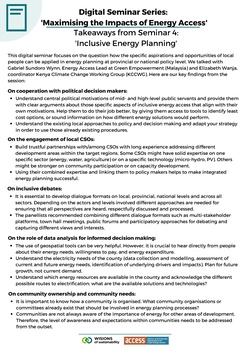
In the seminar the speakers stressed the importance of considering the motivations of mid- and high-level public servants in energy access. Providing these officials with compelling arguments that align with the perspectives of local communities on inclusive energy access is key for inclusive planning.
It was emphasized, that policy players and officials often the lack empirical basis to make informed decisions. Empowering them by granting access to modeling tools and reliable information for cost-effective options and performance evaluations of different energy solutions is essential.
Drawing from the experiences in Malaysia and Kenya, the panelists strongly recommended to build trustworthy partnerships between Civil Society Organizations (CSOs) and policymakers. With different dialogue formats at all levels diverse perspectives can be captured and integrated energy planning can be realised. Tried formats include: multi-stakeholder platforms, town hall meetings, and participatory approaches.
Finally, data collection and analysis are highlighted by both panelists, in order to ensure, that decision have an empirical basis. Important parameters are the electricity needs and available energy resources for electrification pathways.
Geospatial tools can be very helpful to analyse countries or regions. However, one should not forget to engage directly with the local communities and what their energy needs, or energy demand truly is. Understanding the organisational structure of communities also helps to raise awareness about the role of energy in development.
Five recommendations have emerged from the discussion:
- Understand the political ecosystems and the motivations of decision makers.
- Combine the diverse expertise of CSOs with a long history of local engagement.
- Ensure inclusive debates.
- Collect and analyse data for informed decision making.
- Consider community ownership and community needs.
You can find the slides used in the seminar on the right hand side.
Speakers
- Elizabeth Wanja, Coordinator, Kenya Climate Change Working Group (KCCWG)
- Gabriel Sundoro Wynn, Energy Access Lead, Green Empowerment
Moderator
Dr. Willington Ortiz, Senior Researcher, Wuppertal Institute, WISIONS Inititative
Documentation
Download a summary with key takeaways here.