Difference between revisions of "Wind Energy - Physics"
From energypedia
***** (***** | *****) |
***** (***** | *****) |
||
| Line 1: | Line 1: | ||
== Wind Power == | == Wind Power == | ||
| − | The power ''P ''of a wind-stream, crossing an area ''A ''with velocity ''v ''is given by | + | The power ''P ''of a wind-stream, crossing an area ''A ''with velocity ''v ''is given by |
<math>P=\frac{1}{2}\rho A v^3</math><br> | <math>P=\frac{1}{2}\rho A v^3</math><br> | ||
| Line 7: | Line 7: | ||
It varies proportional to air density <math>\rho</math>, to the crossed area ''A ''and to the cube of wind velocity ''v''. | It varies proportional to air density <math>\rho</math>, to the crossed area ''A ''and to the cube of wind velocity ''v''. | ||
| − | The Power ''P ''is the kinetic energy | + | The Power ''P ''is the kinetic energy |
| − | <math>E=\frac{1}{2}mv^2</math> | + | <math>E=\frac{1}{2}mv^2</math> |
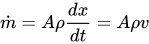
| − | of the air-mass crossing the area ''A ''during a time interval | + | of the air-mass ''m ''crossing the area ''A ''during a time interval <br> |
| − | <math>\dot{m}=A \rho \frac{dx}{dt}=A\rho v</math> | + | <math>\dot{m}=A \rho \frac{dx}{dt}=A\rho v</math>. |
| + | |||
| + | Because power is energy per time unit, combining the two equations leads back to the primary mentioned basic relationship of wind energy utilisation | ||
| + | |||
| + | <math>P=\dot{E}=\frac{1}{2}*\dot{m}*v^2=\frac{1}{2}\rho A v^3</math> | ||
Revision as of 17:51, 16 May 2011
Wind Power
The power P of a wind-stream, crossing an area A with velocity v is given by

It varies proportional to air density , to the crossed area A and to the cube of wind velocity v.

The Power P is the kinetic energy

of the air-mass m crossing the area A during a time interval
.
Because power is energy per time unit, combining the two equations leads back to the primary mentioned basic relationship of wind energy utilisation