Difference between revisions of "YouthEnergy"
***** (***** | *****) m Tag: 2017 source edit |
***** (***** | *****) m |
||
| Line 25: | Line 25: | ||
Download in: | Download in: | ||
| − | * [https://energypedia.info/images/ | + | * [https://energypedia.info/images/a/ab/Strengthening_Youth_Agency_Capacities_booklet_workshop-YouthEnergy_2026.pdf English] |
Published in 2026 | Published in 2026 | ||
</div> | </div> | ||
Revision as of 09:47, 12 November 2026
Conocimiento - Knowledge
Innovación - Innovation
Participación - Participation
Lessons learnt
Resources / Guias Didacticas
Strengthening Youth Agency – Booklet

Strengthening Youth Agency – Booklet
This booklet documents the outcomes of the workshop Strengthening Youth Agencyfor Climate Protection and Energy Transition, held on March 27, 2026, at theNewClimate Institute in Cologne. The event was jointly organized by School4future, Teachers for Future, and YouthEnergy initiatives, bringing together practitioners, educators, researchers, and project representatives from German and Argentine contexts. It was conceived as a space for exchange among initiatives working at the intersection of youth engagement, climate protection, and energy transitions, with the aim of fostering mutual learning and identifying pathways for cooperation across different institutional and geographical settings
Download in:
Published in 2026
Pre-Feasibility Study on Electric Mobility in the Galkot-Badigad-Nisi Corridor
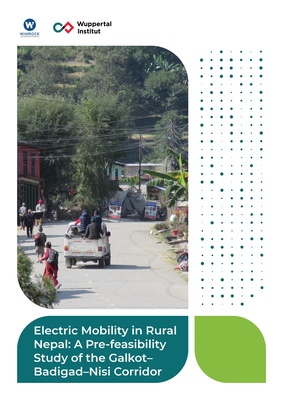
Pre-Feasibility Study on Electric Mobility in the Galkot-Badigad-Nisi Corridor
The Pre-feasibility Study for Electric Mobility in the Galkot-Badigad-Nisikhola Corridor explores the opportunities for deploying electric vehicles (EVs) as an alternative to the region’s urgent need for affordable and sustainable public transport. To evaluate this potential, the research combined field visits, key informant interviews (KIIs), structured surveys with driver and passengers to capture the local mobility pattern and service needs. It also employs financial modelling to assess the technical, socio-economic, and operational feasibility of deploying EVs along key routes in the corridor.
Download in:
Published in 2025