
Difference between revisions of "Wind Energy - Physics"
From energypedia
***** (***** | *****) |
***** (***** | *****) |
||
| Line 1: | Line 1: | ||
| − | |||
| − | |||
| − | |||
| − | |||
| − | |||
| − | |||
| − | |||
| − | |||
| − | |||
| − | |||
| − | |||
| − | |||
| − | |||
| − | |||
| − | |||
| − | |||
| − | |||
| − | |||
| − | |||
| − | |||
== Wind Power == | == Wind Power == | ||
| Line 41: | Line 21: | ||
<br> | <br> | ||
| − | The power of a wind-stream is transformed into mechanical energy by a wind turbine through slowing down the moving air-mass which is crossing the rotor area. For a complete extraction of power the air-mass would have to be stopped completely, leaving no space for the following air-masses. | + | The power of a wind-stream is transformed into mechanical energy by a wind turbine through slowing down the moving air-mass which is crossing the rotor area. For a complete extraction of power, the air-mass would have to be stopped completely, leaving no space for the following air-masses. |
| + | |||
| + | == Unit abbreviations<br> == | ||
| + | |||
| + | {| cellspacing="1" cellpadding="1" border="0" align="left" width="399" style="" | ||
| + | |- | ||
| + | | m = metre = 3.28 ft.<br> | ||
| + | | HP = horsepower<br> | ||
| + | |- | ||
| + | | s = second<br> | ||
| + | | J = Joule<br> | ||
| + | |- | ||
| + | | h = hour<br> | ||
| + | | cal = calorie<br> | ||
| + | |- | ||
| + | | N = Newton<br> | ||
| + | | toe = tonnes of oil equivalent<br> | ||
| + | |- | ||
| + | | W = Watt<br> | ||
| + | | Hz = Hertz (cycles per second)<br> | ||
| + | |} | ||
Revision as of 16:17, 17 May 2011
Wind Power
The power P of a wind-stream, crossing an area A with velocity v is given by

It varies proportional to air density , to the crossed area A and to the cube of wind velocity v.

The Power P is the kinetic energy

of the air-mass m crossing the area A during a time interval
.
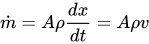
Because power is energy per time unit, combining the two equations leads back to the primary mentioned basic relationship of wind energy utilisation

The power of a wind-stream is transformed into mechanical energy by a wind turbine through slowing down the moving air-mass which is crossing the rotor area. For a complete extraction of power, the air-mass would have to be stopped completely, leaving no space for the following air-masses.
Unit abbreviations
| m = metre = 3.28 ft. |
HP = horsepower |
| s = second |
J = Joule |
| h = hour |
cal = calorie |
| N = Newton |
toe = tonnes of oil equivalent |
| W = Watt |
Hz = Hertz (cycles per second) |