Difference between revisions of "Biogas Saves Women Time and Fosters Their Independence"
***** (***** | *****) |
***** (***** | *****) |
||
| Line 1: | Line 1: | ||
{{GBE ProjectDB | {{GBE ProjectDB | ||
| − | |GBE project name=Biogas Saves Women Time and | + | |GBE project name=Biogas Saves Beninese Women Time and Fosters Their Independence |
|GBE organisation=Vert-Monde | |GBE organisation=Vert-Monde | ||
|GBE date start=June 2022 | |GBE date start=June 2022 | ||
Latest revision as of 07:49, 7 May 2024
Biogas Saves Beninese Women Time and Fosters Their Independence
Key Data
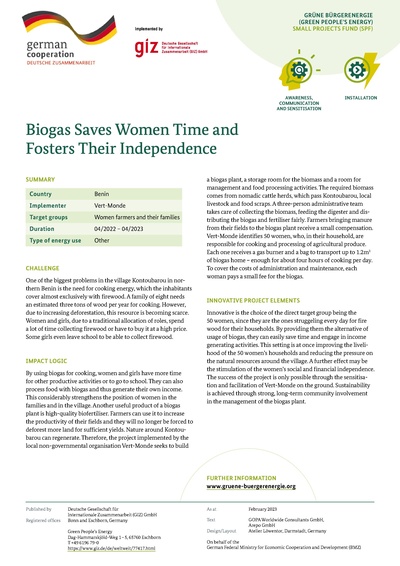
Farmers can use it to increase the productivity of their fields and they will no longer be forced to deforest more land for sufficient yields. Nature around Kontoubarou can regenerate. Therefore, the project implemented by the local non-governmental organisation Vert-Monde seeks to build a biogas plant, a storage room for the biomass and a room for management and food processing activities. The required biomass comes from nomadic cattle herds, which pass Kontoubarou, local livestock and food scraps. A three-person administrativeteam takes care of collecting the biomass, feeding the digester and distributing the biogas and fertiliser fairly. Farmers bringing manure from their fields to the biogas plant receive a small compensation. Vert-Monde identifies 50 women, who, in their household, are responsible for cooking and processing of agricultural produce. Each one receives a gas burner and a bag to transport up to 1.2m3 of biogas home – enough for about four hours of cooking per day.
To cover the costs of administration and maintenance, each woman pays a small fee for the biogas. Innovative is the choice of the direct target group being the 50 women, since they are the ones struggeling every day for fire wood for their households. By providing them the alternative of usage of biogas, they can easily save time and engage in income generating activities. This setting is at once improving the livelihood of the 50 women’s households and reducing the pressure on the natural resources around the village. A further effect may be the stimulation of the women’s social and financial independence. The success of the project is only possible through the sensitisation and facilitation of Vert-Monde on the ground. Sustainability is achieved through strong, long-term community involvement in the management of the biogas plant.- Productive Use
- Gender
Location