Difference between revisions of "Renewable Energy for Marginalised Communities"
From energypedia
***** (***** | *****) |
***** (***** | *****) |
||
| (4 intermediate revisions by one other user not shown) | |||
| Line 1: | Line 1: | ||
{{GBE ProjectDB | {{GBE ProjectDB | ||
| − | |GBE project name=Renewable Energy for Marginalised Communities | + | |GBE project name=Renewable Energy Access and Training for Marginalised Communities in the Omaheke Region in Namibia |
|GBE organisation=Desert Research Foundation of Namibia (DRFN) | |GBE organisation=Desert Research Foundation of Namibia (DRFN) | ||
|GBE date start=July 2022 | |GBE date start=July 2022 | ||
| − | |GBE date end= | + | |GBE date end=September 2023 |
|GBE project description=The project provides a comprehensive electrification scheme to the communities of the sub-villages Donkerbos and Sonneblom in the Omaheke region. This includes the distribution and installation of solar-powered home systems for 72 households, electrification of the local crèche and community centre, as well as the installation of 25 solar streetlights in five sub-villages. In addition to these installations, citizens also receive comprehensive trainings. During installation of the solar home systems, ten San women are trained in basic solar installation and maintenance techniques. The second part of the project aims to establish two community-run gardens in proximity to the existing boreholes in Donkerbos and Pietsepos village. Up to 40 members of the community receive training on solar-powered irrigation and gardening techniques to ensure year round harvests. In combination, these measures minimize the negative environmental impacts of burning firewood, improve safety at night, strengthen the role of women in their communities and provide much needed electricity for all households. | |GBE project description=The project provides a comprehensive electrification scheme to the communities of the sub-villages Donkerbos and Sonneblom in the Omaheke region. This includes the distribution and installation of solar-powered home systems for 72 households, electrification of the local crèche and community centre, as well as the installation of 25 solar streetlights in five sub-villages. In addition to these installations, citizens also receive comprehensive trainings. During installation of the solar home systems, ten San women are trained in basic solar installation and maintenance techniques. The second part of the project aims to establish two community-run gardens in proximity to the existing boreholes in Donkerbos and Pietsepos village. Up to 40 members of the community receive training on solar-powered irrigation and gardening techniques to ensure year round harvests. In combination, these measures minimize the negative environmental impacts of burning firewood, improve safety at night, strengthen the role of women in their communities and provide much needed electricity for all households. | ||
| − | The Omaheke region has so far received comparatively little attention in terms of measures and projects aimed at | + | |
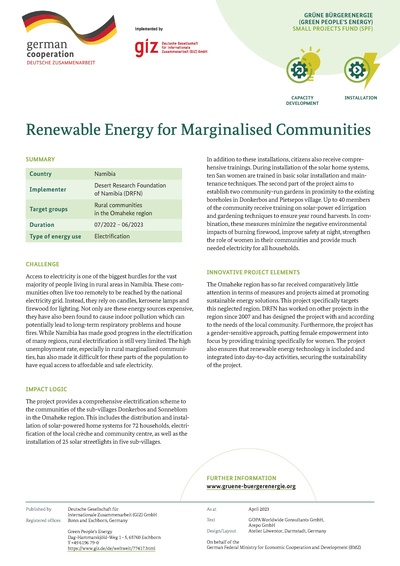
| − | promoting sustainable energy solutions. This project specifically targets this neglected region. DRFN has worked on other projects in the region since 2007 and has designed the project with and according to the needs of the local community. Furthermore, the project has a gender-sensitive approach, putting female empowerment into focus by providing training specifically for women. The project also ensures that renewable energy technology is included and integrated into day-to-day activities, securing the sustainability of the project. | + | The Omaheke region has so far received comparatively little attention in terms of measures and projects aimed at promoting sustainable energy solutions. This project specifically targets this neglected region. DRFN has worked on other projects in the region since 2007 and has designed the project with and according to the needs of the local community. Furthermore, the project has a gender-sensitive approach, putting female empowerment into focus by providing training specifically for women. The project also ensures that renewable energy technology is included and integrated into day-to-day activities, securing the sustainability of the project. |
|GBE financed=Small Projects Fund | |GBE financed=Small Projects Fund | ||
|GBE category gender=Gender | |GBE category gender=Gender | ||
| − | |||
|GBE category enaccess=Energy Access | |GBE category enaccess=Energy Access | ||
|GBE countrySPF=Namibia | |GBE countrySPF=Namibia | ||
Latest revision as of 09:01, 22 May 2024
Renewable Energy Access and Training for Marginalised Communities in the Omaheke Region in Namibia
Last edit made by Stefan Eibisch on 2024-05-22. This is a wiki, do not hesitate to update information by clicking on "Edit with form".
Key Data
Organisation
Desert Research Foundation of Namibia (DRFN)
Duration
July 2022 - September 2023
Project Description
The project provides a comprehensive electrification scheme to the communities of the sub-villages Donkerbos and Sonneblom in the Omaheke region. This includes the distribution and installation of solar-powered home systems for 72 households, electrification of the local crèche and community centre, as well as the installation of 25 solar streetlights in five sub-villages. In addition to these installations, citizens also receive comprehensive trainings. During installation of the solar home systems, ten San women are trained in basic solar installation and maintenance techniques. The second part of the project aims to establish two community-run gardens in proximity to the existing boreholes in Donkerbos and Pietsepos village. Up to 40 members of the community receive training on solar-powered irrigation and gardening techniques to ensure year round harvests. In combination, these measures minimize the negative environmental impacts of burning firewood, improve safety at night, strengthen the role of women in their communities and provide much needed electricity for all households.
GBE Component
Small Projects Fund
Categories
- Gender
- Energy Access
Factsheet
Location
Country SPF
Namibia
Geographic coordinates of project site
22° 23' 23.10" S, 18° 37' 6.64" E
Latitude Longitude