Difference between revisions of "Wind Energy - Physics"
***** (***** | *****) m |
***** (***** | *****) m |
||
| (4 intermediate revisions by 2 users not shown) | |||
| Line 1: | Line 1: | ||
| − | = | + | |
| + | [[Portal:Wind|► Back to Wind Portal]] | ||
| + | |||
| + | = Overview - Wind Power = | ||
The power ''P ''of a wind-stream, crossing an area ''A ''with velocity ''v ''is given by | The power ''P ''of a wind-stream, crossing an area ''A ''with velocity ''v ''is given by | ||
| − | + | <math>P=\frac{1}{2}\rho A v^3</math><br/> | |
| − | It varies proportional to air density < | + | It varies proportional to air density <math>\rho</math>, to the crossed area ''A ''and to the cube of wind velocity ''v''. |
The Power ''P ''is the kinetic energy | The Power ''P ''is the kinetic energy | ||
| − | + | <math>E=\frac{1}{2}mv^2</math> | |
| − | of the air-mass ''m ''crossing the area ''A | + | of the air-mass ''m ''crossing the area ''A ''during a time interval<br/> |
| − | + | <math>\dot{m}=A \rho \frac{dx}{dt}=A\rho v</math>. | |
Because power is energy per time unit, combining the two equations leads back to the primary mentioned basic relationship of wind energy utilisation | Because power is energy per time unit, combining the two equations leads back to the primary mentioned basic relationship of wind energy utilisation | ||
| − | + | <math>P=\dot{E}=\frac{1}{2}\dot{m}v^2=\frac{1}{2}\rho A v^3</math> | |
| + | |||
| + | The power of a wind-stream is transformed into mechanical energy by a wind turbine through slowing down the moving air-mass which is crossing the rotor area. For a complete extraction of power, the air-mass would have to be stopped completely, leaving no space for the following air-masses. Betz and Lanchester found, that the maximum energy can be extracted from a wind-stream by a wind turbine, if the relation of wind velocities in front of (<math>v_1</math>) and behind the rotor area (<math>v_2</math>) is <math>v_1/v_2=1/3</math>. The maximum power extracted is then given by<br/> | ||
| − | + | <math>P_{Betz}=\frac{1}{2} \rho A v^3 c_{P.Betz}</math> | |
| − | + | where <math>c_{p.Betz}=0,59</math> is the power coefficient giving the ratio of the total amount of wind energy which can be extracted theoretically, if no losses occur. Even for this ideal case only 59% of wind energy can be used. In practice power coefficients are smaller: todays wind turbines with good blade profiles reach values of <math>c_{p.Betz}=0,5</math>. | |
| − | + | <br/> | |
| − | + | = Unit Abbreviations = | |
| − | {| | + | {| border="0" align="left" cellspacing="1" cellpadding="1" style="width: 399px" |
|- | |- | ||
| m = metre = 3.28 ft.<br/> | | m = metre = 3.28 ft.<br/> | ||
| Line 45: | Line 50: | ||
|} | |} | ||
| + | <br/> | ||
| + | <br/> | ||
| + | <br/> | ||
| + | <br/> | ||
| + | <br/> | ||
| + | <math>10^{-12}</math> = p pico = 1/1000,000,000,000 | ||
| + | <math>10^{-9}</math> = n nano = 1/1000,000,000 | ||
| + | <math>10^{-6}</math> = µ micro = 1/1000,000 | ||
| − | < | + | <math>10^{-3}</math> = m milli = 1/1000 |
| − | < | + | <math>10^{3}</math> = k kilo = 1,000 = thousands |
| − | < | + | <math>10^{6}</math> = M mega = 1,000,000 = millions |
| − | < | + | <math>10^{9}</math> = G giga = 1,000,000,000 |
| − | < | + | <math>10^{12}</math> = T tera = 1,000,000,000,000 |
| − | < | + | <math>10^{15}</math> = P peta = 1,000,000,000,000,000 |
| − | < | + | <br/> |
| − | + | = Further Information = | |
| − | + | *[[Wind Energy - Introduction|Wind Energy - Introduction]] | |
| + | <br/> | ||
| + | = References = | ||
| − | + | <references /> | |
[[Category:Wind]] | [[Category:Wind]] | ||
Latest revision as of 09:38, 12 August 2014
Overview - Wind Power
The power P of a wind-stream, crossing an area A with velocity v is given by
Failed to parse (MathML with SVG or PNG fallback (recommended for modern browsers and accessibility tools): Invalid response ("Math extension cannot connect to Restbase.") from server "https://wikimedia.org/api/rest_v1/":): {\displaystyle P=\frac{1}{2}\rho A v^3}
It varies proportional to air density Failed to parse (MathML with SVG or PNG fallback (recommended for modern browsers and accessibility tools): Invalid response ("Math extension cannot connect to Restbase.") from server "https://wikimedia.org/api/rest_v1/":): {\displaystyle \rho} , to the crossed area A and to the cube of wind velocity v.
The Power P is the kinetic energy
Failed to parse (MathML with SVG or PNG fallback (recommended for modern browsers and accessibility tools): Invalid response ("Math extension cannot connect to Restbase.") from server "https://wikimedia.org/api/rest_v1/":): {\displaystyle E=\frac{1}{2}mv^2}
of the air-mass m crossing the area A during a time interval
.
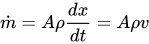
Because power is energy per time unit, combining the two equations leads back to the primary mentioned basic relationship of wind energy utilisation

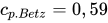
The power of a wind-stream is transformed into mechanical energy by a wind turbine through slowing down the moving air-mass which is crossing the rotor area. For a complete extraction of power, the air-mass would have to be stopped completely, leaving no space for the following air-masses. Betz and Lanchester found, that the maximum energy can be extracted from a wind-stream by a wind turbine, if the relation of wind velocities in front of () and behind the rotor area () is . The maximum power extracted is then given by


where is the power coefficient giving the ratio of the total amount of wind energy which can be extracted theoretically, if no losses occur. Even for this ideal case only 59% of wind energy can be used. In practice power coefficients are smaller: todays wind turbines with good blade profiles reach values of .

Unit Abbreviations
| m = metre = 3.28 ft. |
HP = horsepower |
| s = second |
J = Joule |
| h = hour |
cal = calorie |
| N = Newton |
toe = tonnes of oil equivalent |
| W = Watt |
Hz = Hertz (cycles per second) |
= p pico = 1/1000,000,000,000

= n nano = 1/1000,000,000

= µ micro = 1/1000,000

= m milli = 1/1000

= k kilo = 1,000 = thousands

= M mega = 1,000,000 = millions

= G giga = 1,000,000,000

Failed to parse (MathML with SVG or PNG fallback (recommended for modern browsers and accessibility tools): Invalid response ("Math extension cannot connect to Restbase.") from server "https://wikimedia.org/api/rest_v1/":): {\displaystyle 10^{12}} = T tera = 1,000,000,000,000
Failed to parse (MathML with SVG or PNG fallback (recommended for modern browsers and accessibility tools): Invalid response ("Math extension cannot connect to Restbase.") from server "https://wikimedia.org/api/rest_v1/":): {\displaystyle 10^{15}} = P peta = 1,000,000,000,000,000
Further Information