
Difference between revisions of "Estimate and Stimulate Demand"
From energypedia
***** (***** | *****) m Tag: 2017 source edit |
***** (***** | *****) m Tag: 2017 source edit |
||
| Line 2: | Line 2: | ||
{{PplSun:Backlink Home}} | {{PplSun:Backlink Home}} | ||
{{PAGENAME}} | {{PAGENAME}} | ||
| + | {{#titleparts: {{PAGENAME}} | | -1 }} | ||
==Definitions== | ==Definitions== | ||
*'''[[Sandbox4|Present]] electricity demand:''' Electrical energy consumed by all inhabitants at the time of the site visit. | *'''[[Sandbox4|Present]] electricity demand:''' Electrical energy consumed by all inhabitants at the time of the site visit. | ||
Revision as of 09:59, 14 March 2023
Estimate and Stimulate Demand Estimate and Stimulate Demand
Definitions
- Present electricity demand: Electrical energy consumed by all inhabitants at the time of the site visit.
- Assessed electricity demand: The amount of electricity that customers state they would use if there was electricity at this moment. It can be assessed by conducting surveys on site.
- (Future) effective electricity demand: The demand that is backed by financial resources and can actually be paid by the consumer (influenced by WTP and ATP).
- Electrical load profiles: The electrical load on a certain time axis, which varies according to customer type, temperature and seasonal effects. An average daily load profile gives insights on the peak load which is required for the load forecasting and plant sizing and the energy demand in kWh to forecast demand and revenues.
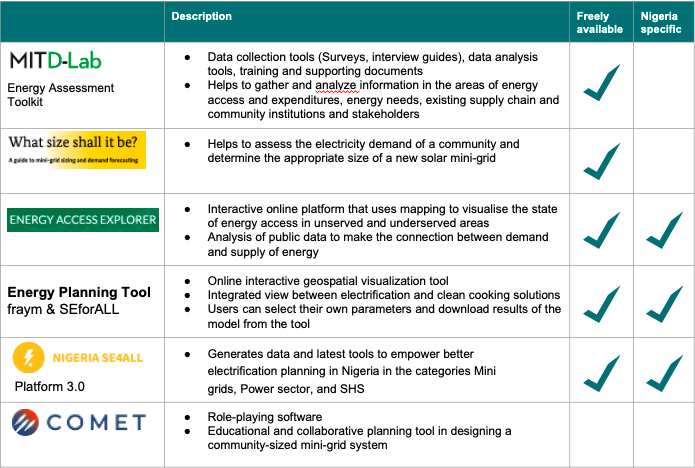
Existing Tools and Resources
1. PeopleSuN demand dataset
- Quantitative survey data
- Open-source dataset
- Answers from 3,599 households and 1,122 enterprises in 225 electrified non-urban villages across three Nigerian geopolitical zones
- Qualitative survey data
- Data from 8 electrified non-urban villages
2. PeopleSuN demand modelling tool
- Modelling of appliance ownership and electricity consumption growth trends for households and enterprises
- Different profiles are created per zone and per atlasAI wealth category, resulting in 10 different consumer categories/profiles
Challenges
Guiding Principles
1. Consider all factors that determine electricity demand
- Community-based information
- Consumer-based information
2. Adjust to local conditions and include the local community
- Use existing data from comparable regions as a basis
- Analysis of local conditions
- Early stage inclusion of local community
- Higher acceptance
- Capacity building
3. Efficient appliances are a relevant component in estimating demand
- Off-grid solar products often do better when associated with efficient appliances
- Affect demand estimation and design of the business model
- E.g. CREEDS raises awareness around energy efficient applications to increase the longevity and reliability of their SHS
Case Study: Green Business Area, Mali

The solution
- Integrated solution that supplies electricity to small enterprises, co-operatives and rural services
- Electricity production is based on renewable energy sources
Status Quo
- Interview in 2022
- Draft to be sent to Geres in the upcoming weeks